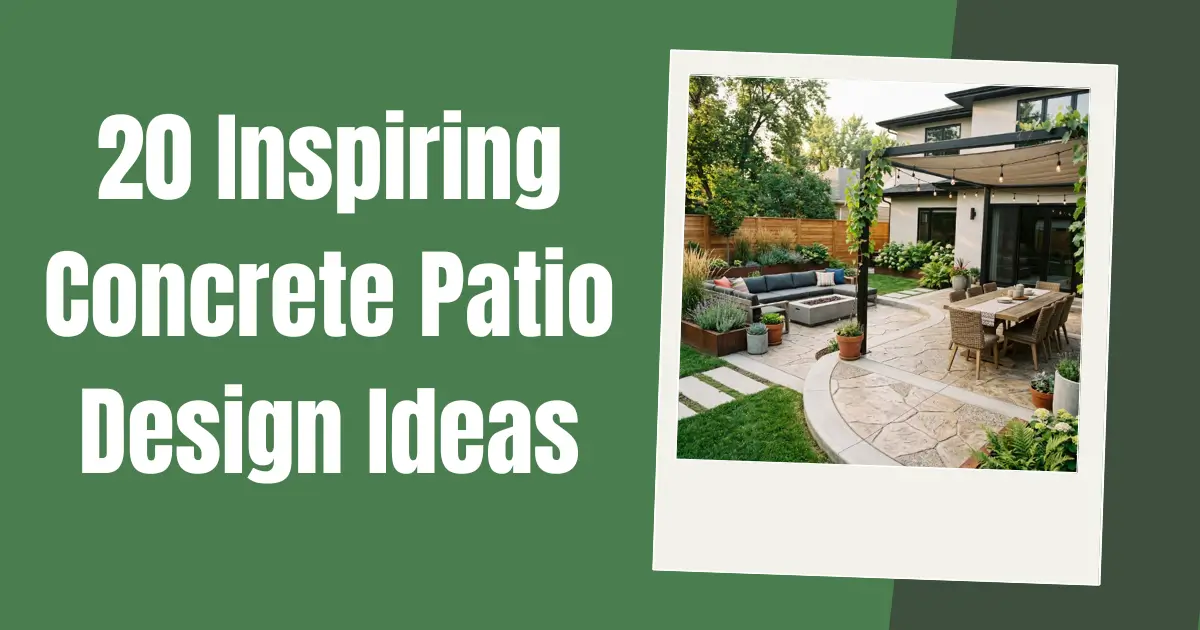
Stamped concrete, exposed aggregate, and stained finishes are the three most popular ways to transform a plain concrete patio into a surface that looks genuinely designed rather than simply poured and forgotten.
Concrete offers more finish, color, and texture options than most homeowners realize. It handles heavy foot traffic, outdoor furniture, and all weather conditions better than almost any other patio material at a comparable price point.
These 20 ideas cover every concrete patio style from simple budget-friendly finishes through to premium decorative surfaces. Each one delivers a result that genuinely refreshes the outdoor space around it.
1. Stamped Concrete Patio
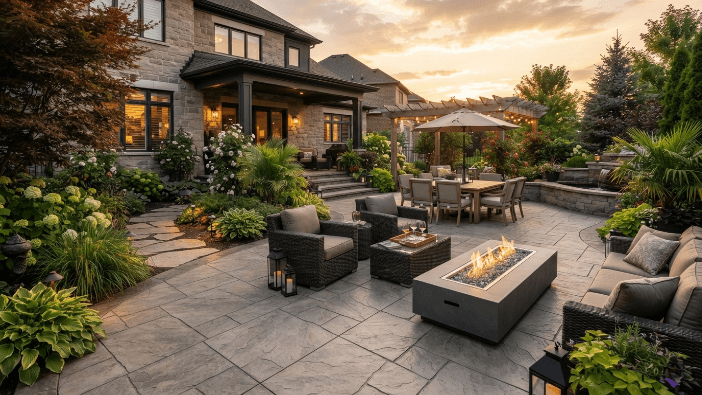
Stamped concrete uses textured molds pressed into freshly poured concrete to replicate the look of natural stone, brick, slate, or timber at a fraction of the real material cost.
The pattern becomes part of the slab rather than a surface coating so it cannot peel or wear away. Sealed regularly a quality stamped concrete patio lasts decades with minimal maintenance.
Most Popular Stamped Concrete Patterns
- Ashlar slate for a refined natural stone appearance
- Cobblestone for a traditional European courtyard character
- Flagstone for an irregular natural stepping stone look
- Herringbone brick for a classic formal patio pattern
- Timber plank for a wood-look surface without the maintenance
2. Exposed Aggregate Concrete
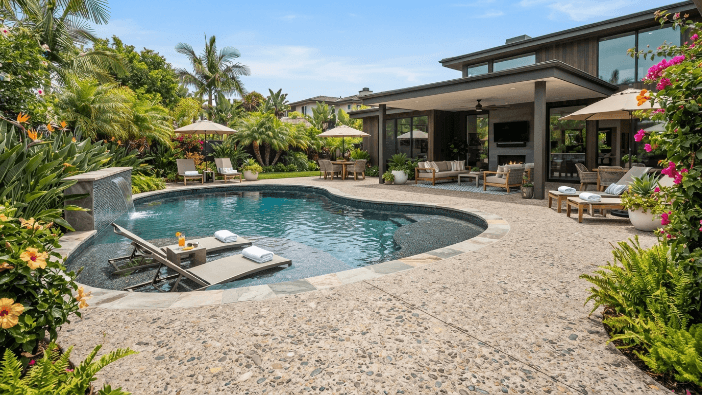
Exposed aggregate removes the smooth cement surface layer to reveal the natural stones and pebbles embedded in the concrete mix. The result is a textured slip-resistant surface that suits garden and pool patio settings particularly well.
The aggregate type and color can be specified before pouring to achieve different surface appearances depending on the style of the surrounding outdoor space.
Exposed Aggregate Finish Options
- River pebble for a smooth rounded natural texture
- Quartz chips for a fine sparkled contemporary surface
- Granite aggregate for a dark dramatic speckled finish
- Recycled glass for a colorful decorative surface option
3. Stained Concrete Patio
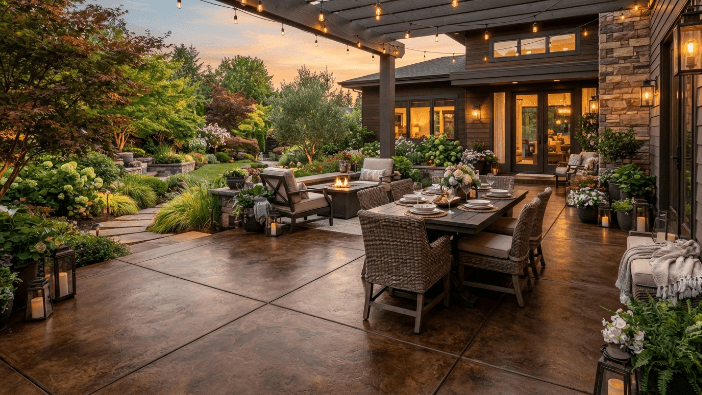
Concrete stain penetrates the surface of an existing or new slab to add permanent color that does not peel, chip, or fade the way paint does over time.
Acid stains create a mottled variegated effect that mimics natural stone. Water-based stains deliver more consistent solid color results and come in a much wider range of colors than acid stain alternatives.
Concrete Stain Type Comparison
- Acid stain for a mottled natural stone-like color variation
- Water-based stain for consistent solid color across the full slab
- Overlay stain for color on an existing worn or damaged slab
4. Polished Concrete Patio
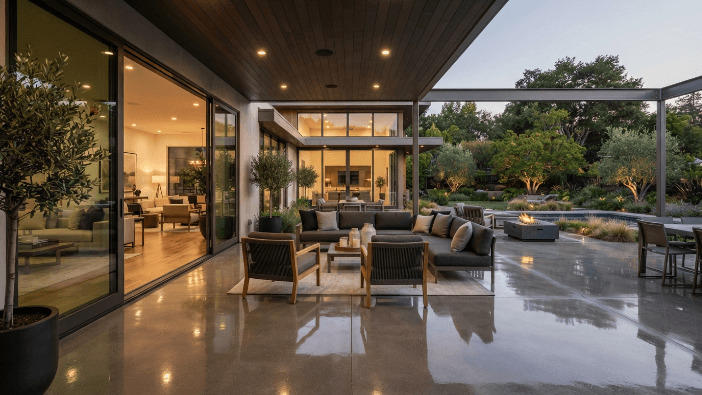
Polished concrete uses a series of progressively finer diamond grinding pads to create a smooth reflective surface that looks closer to an indoor floor finish than a standard outdoor patio surface.
It suits covered patio areas and outdoor rooms better than fully exposed positions because the smooth surface becomes slippery when wet. A light grip finish can be applied to the final polish to manage slip risk in rain-exposed positions.
Polished Concrete Finish Levels
- Cream polish for a soft low-sheen natural concrete look
- Salt and pepper finish for a fine aggregate visible surface
- Full aggregate expose for a highly reflective premium finish
- Matte sealer option for sheen control in outdoor positions
5. Painted Concrete Patio
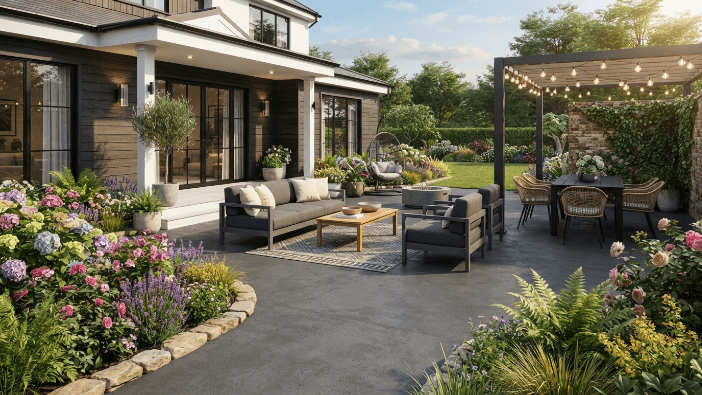
Painting an existing concrete patio is the fastest and most affordable way to completely change the look of an outdoor surface in a single weekend. Exterior-grade concrete paint in a solid color or a two-tone pattern creates a fresh result that costs a fraction of any resurfacing alternative.
Use a concrete-specific exterior paint with a slip-resistant additive mixed in for any outdoor surface that gets wet. Standard interior or exterior wall paint deteriorates quickly on a concrete floor surface under foot traffic and outdoor exposure.
Painted Patio Color Ideas
- Warm white for a bright coastal or Hamptons-inspired look
- Charcoal grey for a bold contemporary patio surface
- Sage green for a relaxed garden-friendly natural tone
- Terracotta for a warm Mediterranean outdoor character
- Navy blue for a dramatic statement patio in a shaded area
6. Concrete Patio With Inlaid Pavers
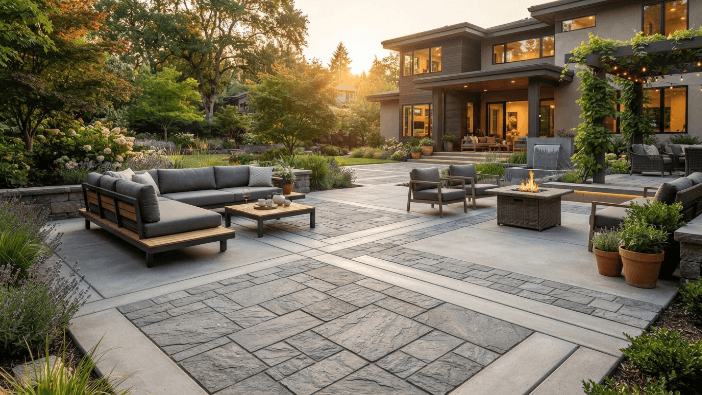
Combining a concrete slab base with inlaid natural stone, brick, or porcelain pavers creates a patio surface with more visual interest and material richness than a plain concrete finish alone.
The pavers are set into the wet concrete or into a prepared bed within a framed concrete slab. The concrete surrounds and locks the pavers permanently in place creating a stable hybrid surface that combines the strength of concrete with the beauty of natural paving materials.
Inlaid Paver Material Options
- Natural slate for a dark textured inlaid pattern
- Terracotta pavers for a warm Mediterranean surface combination
- Porcelain tiles for a clean contemporary inlaid finish
- Reclaimed brick for a rustic characterful inlaid detail
7. Broom Finished Concrete
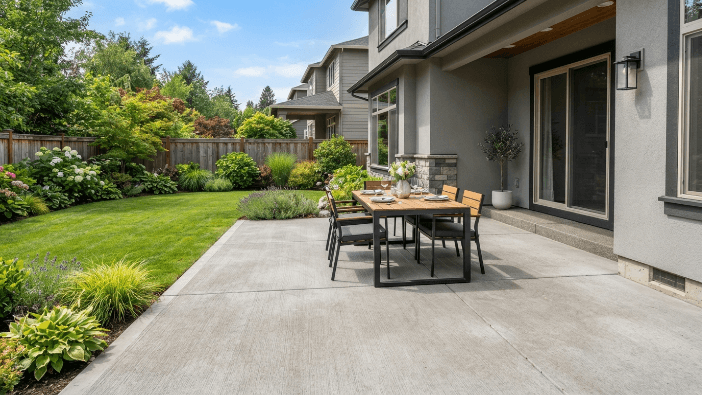
Broom finishing drags a stiff brush across freshly poured concrete to create a lightly textured slip-resistant surface that is the most practical and cost-effective concrete finish available for a standard outdoor patio.
It is the default finish used by most concreters for outdoor slabs because it performs reliably in all weather conditions and requires no specialist equipment or additional materials beyond the basic concrete pour.
Why Broom Finish Works So Well Outdoors
- Natural slip resistance in wet weather conditions
- Most affordable concrete finish available
- No specialist equipment or additional materials required
- Suits any backyard style without competing visually
8. Concrete Patio With Decorative Borders
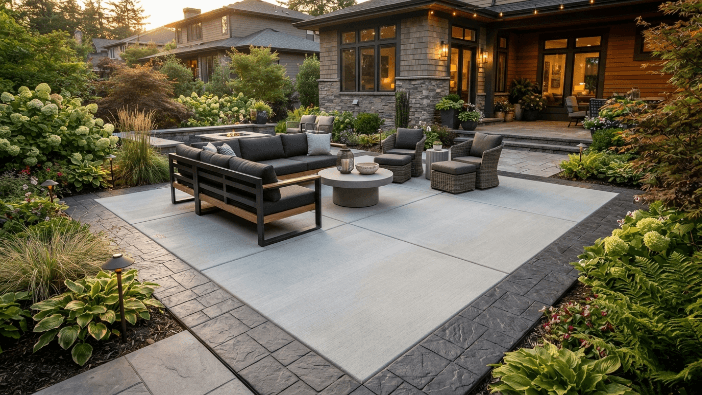
Adding a decorative border in a contrasting color, pattern, or material around the perimeter of a concrete patio gives a plain slab a designed and finished quality without resurfacing the entire surface.
A 300mm wide border in a contrasting stamp pattern or a different aggregate color frames the patio visually and creates a transition between the slab and the surrounding garden or lawn area that looks deliberately planned.
Decorative Border Ideas for a Concrete Patio
- Contrasting stamp pattern border around a plain center slab
- Exposed aggregate border with a smooth broom finished center
- Brick soldier course border set into the outer edge of the slab
- Dark colored concrete border around a lighter center finish
- Inlaid timber sleeper border for a warm natural edge detail
Pro Tip: Always seal your concrete patio before first use and reseal every two to three years. Sealing prevents staining from outdoor furniture, food, and plant matter and extends the life of any decorative finish significantly.
9. Geometric Patterned Concrete
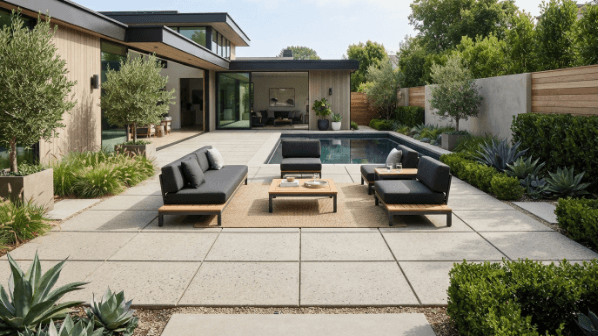
Using saw cuts, control joints, or different pour sections to create geometric patterns across the surface of a concrete patio adds a graphic quality to the surface that suits contemporary and minimalist outdoor design styles particularly well.
Large format square or rectangular grid patterns created with saw cuts give a plain broom-finished slab a modern designed quality for very little additional cost beyond the standard pour and finish work.
Geometric Pattern Ideas for a Concrete Patio
- Large square grid saw cut pattern for a contemporary look
- Diagonal cut pattern for visual movement across the surface
- Mixed rectangle sizes for an irregular modern layout
- Herringbone cut pattern for a classic directional surface detail
10. Concrete Overlay Resurfacing
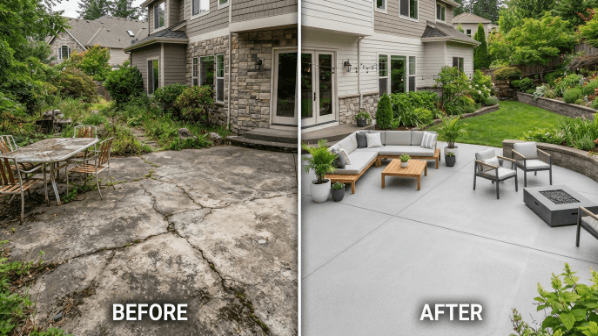
Concrete overlay resurfacing applies a thin layer of polymer-modified concrete over an existing worn, cracked, or stained slab to create a fresh new surface without the cost and disruption of demolishing and replacing the original concrete.
The overlay can be stamped, stained, textured, or smoothed to any finish and the result looks indistinguishable from a new concrete pour. This is the most cost-effective renovation option for an existing concrete patio that is structurally sound but visually past its best.
Concrete Overlay Finish Options
- Microtopping for an ultra-thin smooth contemporary finish
- Stampable overlay for a decorative stamped pattern on old concrete
- Spray texture for a fine uniform surface coating
- Self-leveling overlay for a smooth flat resurfaced result
11. Concrete Patio With Timber Accents
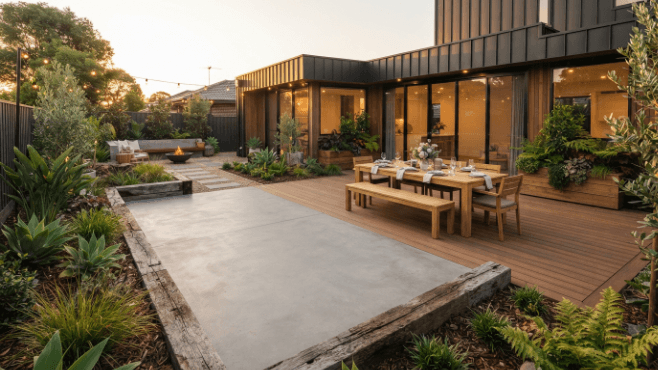
Incorporating timber decking sections, timber sleeper borders, or timber furniture into a concrete patio scheme creates a warm material contrast that makes the overall outdoor space feel more layered and considered than an all-concrete surface design.
Composite timber is the most practical choice for sections integrated into or directly alongside a concrete patio because it handles the moisture contact and ground proximity that accelerates rot in natural timber without any annual sealing or treatment.
Timber and Concrete Combination Ideas
- Composite timber deck section beside the main concrete slab
- Reclaimed timber sleeper border framing the concrete edge
- Timber furniture on a concrete slab for material contrast
- Timber planter boxes positioned on a decorative concrete surface
12. Coloured Concrete Patio
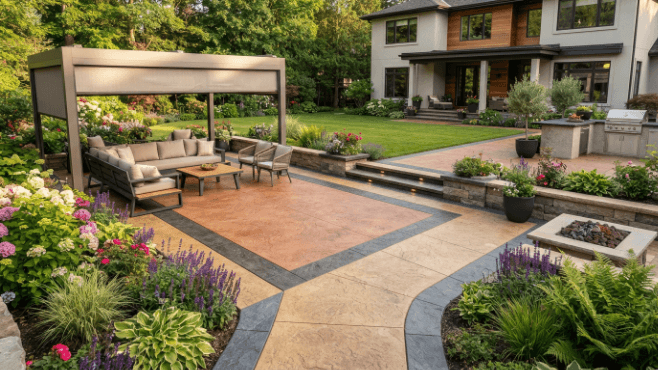
Adding integral color pigment to the concrete mix before pouring creates a patio surface with consistent color throughout the full depth of the slab. Unlike surface stains and paints integral color cannot chip, peel, or fade from the surface because the color goes all the way through the material.
Oxide pigments in earthy tones like terracotta, sandstone, charcoal, and slate grey are the most popular choices for colored concrete patios because they complement outdoor garden and landscape settings naturally without competing with surrounding planting and materials.
Popular Integral Concrete Colors
- Terracotta for a warm Mediterranean outdoor character
- Sandstone for a neutral warm tone that suits most garden styles
- Charcoal grey for a bold contemporary patio surface color
- Slate grey for a cooler more refined contemporary finish
13. Concrete Patio With Built-In Fire Pit
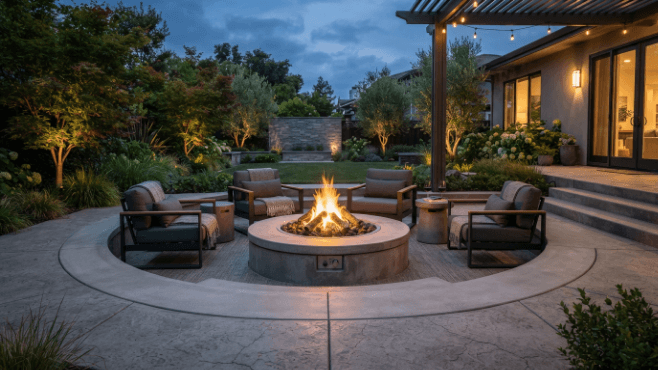
Building a fire pit directly into the center or at one end of a concrete patio creates a permanent outdoor entertaining feature that anchors the whole outdoor space and provides warmth that extends the usable season of the patio well into autumn and winter.
Surround the fire pit with a non-combustible concrete or stone border at least 600mm wide on all sides. This protects the surrounding patio surface from heat damage and creates a visual separation between the fire zone and the surrounding seating area.
Fire Pit Integration Details
- Non-combustible border minimum 600mm wide around the pit
- Recessed gas fire pit for a clean flush surface installation
- Raised concrete rim around the pit for casual seating use
- Drainage provision below the pit for rain water management
14. Concrete Patio With Garden Bed Cutouts
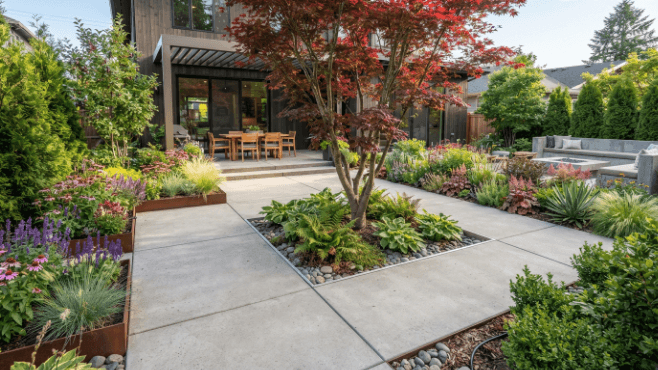
Leaving planned cutouts in a concrete patio slab for garden beds, feature trees, or planter zones creates a patio design that integrates greenery directly into the hardscape rather than pushing plants to the edges or perimeter of the space.
A single large cutout in the center of a concrete patio for a feature tree or a series of smaller cutouts along one edge for a garden bed creates a far more dynamic and interesting outdoor space than a solid unbroken slab surrounded by separate garden areas.
Garden Cutout Ideas for a Concrete Patio
- Central single cutout for a feature tree or large ornamental grass
- Edge cutouts along one side for a continuous garden bed strip
- Corner cutouts for tall screening plants at the patio boundary
- Random scattered small cutouts for a naturalistic planting pattern
- Rectangular cutouts for raised planter box integration
Pro Tip: Plan garden bed cutouts and drainage before pouring any concrete. Adding them to an existing slab requires cutting and breaking which costs significantly more than designing them into the original pour.
15. Honed Concrete Patio
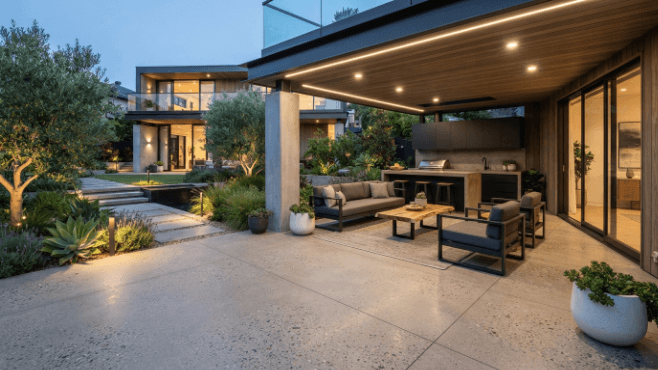
Honed concrete uses diamond grinding to cut back the surface of a concrete slab to reveal a smooth flat finish that sits between the rough texture of a broom finish and the high sheen of a full polish.
The result is a refined matte surface with a consistent texture that suits contemporary outdoor living spaces and covered patio areas particularly well. A light anti-slip additive in the sealer makes it suitable for uncovered outdoor positions exposed to rain.
Honed Concrete Finish Characteristics
- Smooth flat surface with a refined matte appearance
- Aggregate partially visible for subtle natural texture
- Suitable for covered and uncovered patio positions with anti-slip sealer
- Easy to clean and maintain with regular sweeping and occasional mopping
16. Concrete Patio With Water Feature Integration
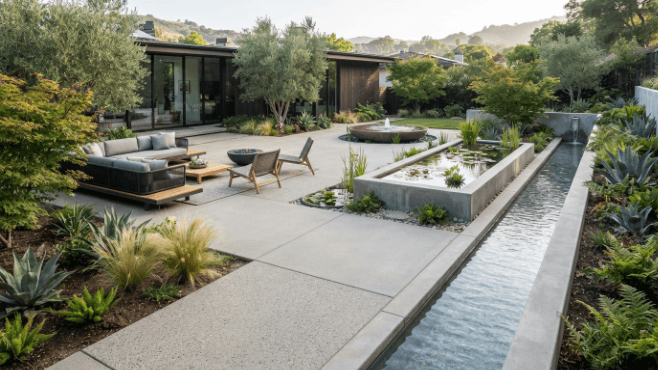
Incorporating a water feature such as a narrow channel, a small pond, or a recessed fountain basin directly into a concrete patio creates a sensory element that no amount of surface decoration or furniture can replicate.
Moving water adds sound, movement, and a cooling effect to the patio environment that makes the space feel genuinely more immersive and private. A concrete water channel running along one edge of the patio is one of the most elegant and low-maintenance water feature options available.
Water Feature Integration Options
- Narrow concrete channel along one patio edge for a linear feature
- Recessed circular fountain basin in the patio center
- Small concrete pond with water plants at the garden bed edge
- Millstone or rock fountain set into a concrete surround
17. Concrete Stepping Stone Patio
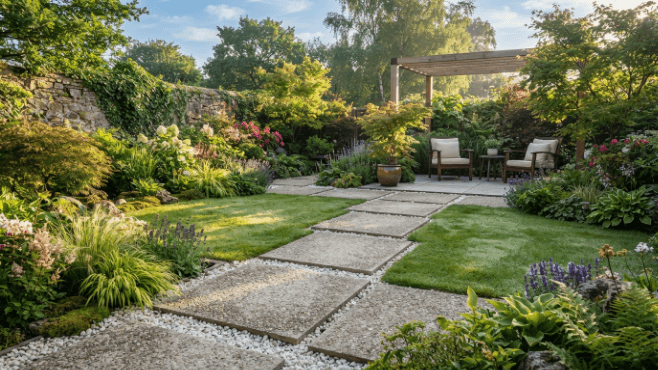
Rather than a solid slab a series of large individual concrete stepping stones set into gravel, lawn, or garden creates a relaxed and naturalistic patio approach that suits cottage gardens, Japanese-inspired landscapes, and informal outdoor spaces where a formal continuous slab would feel too rigid and structured.
Precast concrete stepping stones in large formats of 600x600mm or 800x800mm create a generous stepping stone path and gathering space that is practical underfoot and visually interesting in a way that a plain poured slab rarely achieves in a naturalistic garden setting.
Stepping Stone Layout Ideas
- Regular grid layout for a structured contemporary garden path
- Irregular scattered layout for a naturalistic garden stepping path
- Set in gravel for a Japanese-inspired dry garden aesthetic
- Set in lawn for a relaxed informal backyard garden approach
18. Concrete Patio With Outdoor Lighting Integration
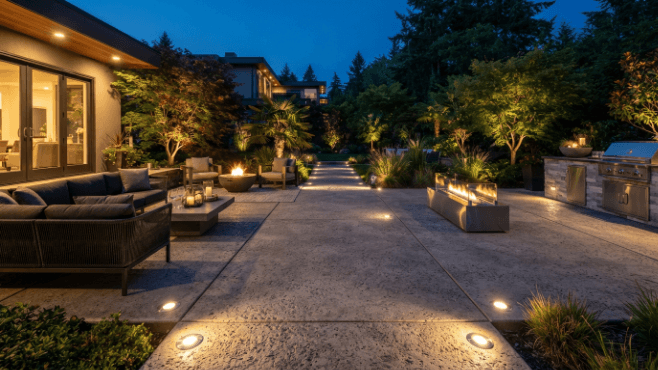
Embedding low-voltage LED lighting directly into a concrete patio slab during the pour creates a permanent lighting installation that illuminates the patio surface from below without any visible fixtures or cabling above the ground plane.
In-ground patio lights in stainless steel housings flush with the concrete surface create a dramatic evening effect that highlights the texture and pattern of the concrete finish while providing practical path and area lighting after dark.
In-Ground Lighting Integration Tips
- Install conduit and wiring before the concrete pour
- Use stainless steel flush housings rated for in-ground use
- Space lights evenly along pathways and patio perimeters
- Connect to a timer or smart home system for automatic operation
- Warm white LEDs for the most comfortable evening patio atmosphere
19. Concrete Patio With Pergola or Pavilion
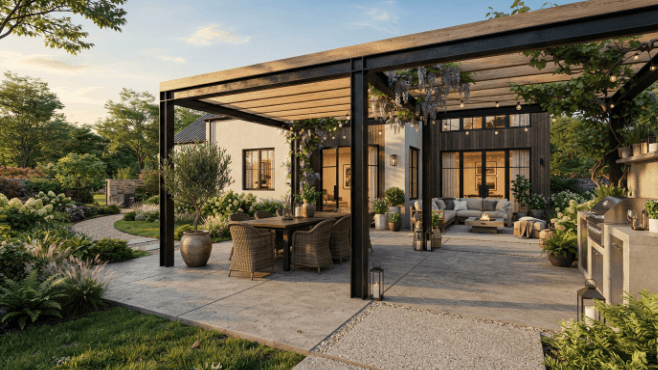
Pouring a concrete patio slab as the base for a pergola or pavilion structure creates the most stable and permanent outdoor living room foundation available. The slab handles post loads, furniture weight, and foot traffic without the movement or settling that occurs with pavers or loose surfaces over time.
Design the slab to extend at least 600mm beyond the pergola or pavilion footprint on the open sides. This creates a usable transition zone between the covered structure and the surrounding garden that makes the outdoor room feel more generous and connected to the broader outdoor space.
Concrete Slab and Pergola Integration Tips
- Extend slab minimum 600mm beyond the structure footprint
- Install post anchor hardware during the pour not after
- Match slab finish to the style of the overhead structure
- Add a decorative border at the slab edge for a finished look
20. Recycled and Sustainable Concrete Patio
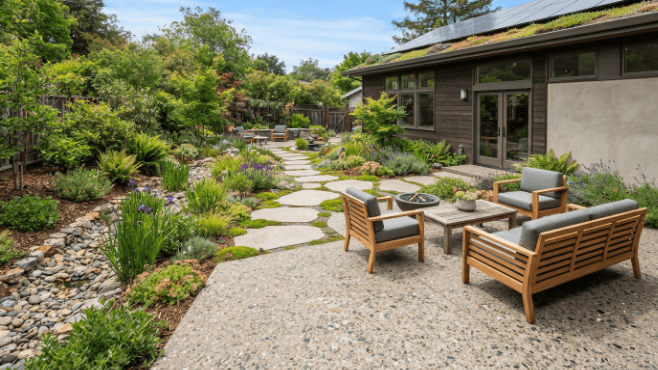
Using recycled aggregate concrete, fly ash blended concrete, or reclaimed concrete pieces as stepping stones creates a patio with a lower environmental footprint than standard concrete without sacrificing strength, durability, or visual quality.
Fly ash blended concrete uses a byproduct of coal combustion to replace a portion of the Portland cement in the mix. The result is a stronger and more durable concrete with a meaningfully lower carbon footprint than a standard mix and no visible difference in the finished patio surface appearance.
Sustainable Concrete Patio Options
- Fly ash blended mix for reduced cement content and carbon footprint
- Recycled aggregate concrete using crushed reclaimed concrete
- Reclaimed concrete pieces as informal stepping stones in garden settings
- Permeable concrete mix for improved stormwater drainage on site
Pro Tip: Get at least three quotes for any concrete patio project and ask each contractor to quote on the same finish specification. Price differences between quotes almost always reflect differences in concrete thickness, reinforcement, and sealer quality rather than simply labor cost variations.
Wrapping It All Up
Concrete is genuinely one of the most flexible and long-lasting patio materials available when the finish is chosen thoughtfully and the slab is laid and sealed correctly from the start.
Every idea on this list works in a real backyard setting across a range of budgets. Start with the finish that suits your outdoor style and your climate and build the rest of the patio design around that single decision.